
Loading model
About
A modern realistic escape room business for building a venue of two or three themed rooms with the operation behind them. The shell is modular: 1.2 by 2.6 m wall modules dressed on both faces, plain painted, walnut panelled, as a venue corridor and as a hidden panel section, a door module with an 800 by 2050 mm leaf on a magnetic lock with a glazed vision port, a false bookcase door whose whole case swings on a concealed hinge, 1.2 m floor tiles plain and with a steel pressure plate in them, and 1.2 m ceiling panels on a tee grid with a camera dome and a speaker. The puzzles are modelled as mechanisms: combination padlocks in three sizes, a key safe with a numbered dial, a keypad wall plate, a three lever panel with red, green and brass knobs, a pipe and valve board with three handwheels and two gauges, a wire patch panel, a balance on a plinth, a UV mark panel with its lamp, a sliding tile frame, a map and pin board, a writing desk with a ledger and quill, a banded chest with hasps, a drawer unit with a false bottom, a mirror on a hidden catch, a candle sconce lever and a floor safe with a spoked handwheel. The venue is the rest of the job: the games master desk with a six monitor bank, talkback microphone and reset tray, the headset, prop store shelving, reception, a waiting sofa, phone and bag lockers, a briefing screen, a leaderboard, venue signage and room name plates, a photo backdrop, drinks vending and a bin. Every leaf, drawer, lever, valve wheel, dial and lid is a named node on its own pivot and ships rigid open, close, spin and tilt clips: node transforms only, no skinning. Padlock shackles stay shut, patch leads and headset cables are modelled in one fixed loop, candle wicks are unlit, pressure plates travel 8 mm and are left static, and the tiles of the sliding puzzle stay where they are, because a flexible run, a flame and fifteen separate tiles are not worth a rigid node transform each. Signs, books, maps, charts, leaderboards and screen faces are abstract blocks and bands, never readable text, so nothing implies a real venue, franchise or brand. Every file is self-contained CC0 geometry with no collision or navigation data.
Files load directly from the CDN. Choose the pieces you need. Colliders, navigation and gameplay scripts are supplied by your game.
Use with an AI agent
Copy this prompt into your AI chat, then describe what you want to build with the pack.
Use the “Escape Room and Puzzle Venue” pack in my project.

Manifest (JSON, every model with its CDN URL): https://3dassets.dev/api/v1/packs/escape-room-and-puzzle-venue
Starter scene (one GLB with every piece placed): https://cdn.3dassets.dev/assets/35814/v1/model.glb
Pack page: https://3dassets.dev/packs/escape-room-and-puzzle-venue
Description: Realistic escape room models: modular puzzle room walls, a door with a magnetic lock, a false bookcase door, padlocks, dials, levers, valve boards and safes, plus the games master desk, prop store, reception, lockers and signage of the venue around them.

- 45 GLB models, 5.9 MB in total
- Units: metres, +Y up, shared scale and palette across the pack
- Licence: CC0 1.0 Universal (no attribution required)
- Loading: three.js GLTFLoader; no additional decoders required. Load models individually from the manifest, or the starter scene as one file.
Also available as a JSON manifest or via the MCP server.
Common questions
How do I use Escape Room and Puzzle Venue with my AI development tools?
How do I get started?
Which game engines and tools can I use Escape Room and Puzzle Venue with?
How do I import this pack into Unity, Godot, Unreal or Blender?
Can I use Escape Room and Puzzle Venue in a commercial game, and do I need to credit anyone?
Can I load it from the CDN instead of downloading it?
Do I have to download the whole pack?
Do the models in Escape Room and Puzzle Venue fit together?
Game kit
Escape Room and Puzzle Venue
Realistic escape room models: modular puzzle room walls, a door with a magnetic lock, a false bookcase door, padlocks, dials, levers, valve boards and safes, plus the games master desk, prop store, reception, lockers and signage of the venue around them.
One GLB with every piece placed in a starter scene. Each model is also below on its own.
View demoEverything in this pack

Puzzle Room Wall Module (Escape Room and Puzzle Venue)
A 1.2 by 2.6 m puzzle room wall module, 120 mm thick, painted plaster over a stud core and dressed on both faces with a walnut skirting and picture rail. Its wall-left and wall-right ports butt module to module, so a themed room of any size closes on the same grid.

Puzzle Room Wall Module, Timber Panelled (Escape Room and Puzzle Venue)
The same 1.2 by 2.6 m wall module dressed as a study: dark walnut lining with two rows of raised panels either side of a brass dado rail, on both faces. Use it to theme one room of a venue without changing the grid.
 Animated
Puzzle Room Wall, Hidden Panel Section (Escape Room and Puzzle Venue)
A panelled wall module with a 700 by 1100 mm section that is really a door: a concealed hinge on its left stile, a brass finger pull and a lined recess behind it with a key bar. Closed it is one more panel in the lining. Same ports as the plain module.
 Animated
Puzzle Room Door Module (Escape Room and Puzzle Venue)
A 1.2 by 2.6 m wall module with an 800 by 2050 mm doorway in it: a framed timber leaf on a brass lever handle with a glazed vision port in a brass surround, a magnetic lock and armature plate at the head with its status lamp, and a closer arm. Same wall ports as the plain module.
 Animated
False Bookcase Door (Escape Room and Puzzle Venue)
A 1.2 m walnut bookcase that is the door out of a study: five shelves of abstract books and a brass candlestick catch on a case 1.08 m wide, on a concealed hinge in its own lining, so the whole case swings out of the wall. Book spines are plain blocks, never readable titles.

Puzzle Room Floor Tile (Escape Room and Puzzle Venue)
A 1.2 m square floor tile 54 mm thick: a dark deck carrying a walnut board face with four brass corner studs. Ports at the four edge midpoints tile a room, a corridor or a whole venue in both directions.

Pressure Plate Floor Tile (Escape Room and Puzzle Venue)
The same 1.2 m floor tile with a 660 mm steel pressure plate in a brass surround set into it and a red state lamp at one corner. The plate travels 8 mm in use, which is too little to read as a clip, so it ships static.

Room Ceiling Panel with Camera Dome (Escape Room and Puzzle Venue)
A 1.2 m square ceiling module on an alloy tee grid: a painted tray panel with a smoked camera dome on its collar and a brass speaker grille, both hanging 90 mm below the face. Ports on the four edges run a ceiling over any room built from the wall modules.

Countdown Wall Clock (Escape Room and Puzzle Venue)
A 380 mm brass cased wall clock for a themed room: a cream dial with plain hour marks, a red countdown arc on the last quarter and two hands on a brass boss. The hands are modelled in one fixed position, because a game clock is counted down by the venue software.
 Animated
Hint Screen Wall Panel (Escape Room and Puzzle Venue)
A 860 by 500 mm hint screen on a wall bracket, the display a games master pushes a clue to: a bezelled case with a lit panel and a status strip, hung on a tilting head. The face is an abstract lit panel, never readable text, so it suits any theme.

Countdown Timer Display Panel (Escape Room and Puzzle Venue)
A 860 by 340 mm timer board for over a room door: six seven-segment digits and two colon dots in red on a dark face, under a brass capping. The segments are lit geometry in one fixed pose, not a readable time, and the board is bolted to the wall, so it does not move.

Venue Corridor Wall Module (Escape Room and Puzzle Venue)
A 1.2 by 2.6 m corridor wall module on the same grid as the puzzle room walls: painted over a teal dado band with a brass capping rail and a blank brass module plate, dressed on both faces. Runs the circulation and the front of house between the themed rooms.

Combination Padlock (Escape Room and Puzzle Venue)
A 62 mm brass bodied combination padlock: a steel shackle through the case and four coded barrels with index bands across the face. The shackle is modelled closed and stays closed, because a lock that falls open is no longer a puzzle.

Combination Padlock, Small (Escape Room and Puzzle Venue)
The same combination padlock at 42 mm, the size that closes a small box, a cash tin or a locker hasp. Shackle closed and static.

Combination Padlock, Large (Escape Room and Puzzle Venue)
The same combination padlock at 96 mm, the size that closes a chest, a gate hasp or a prop cage. Shackle closed and static.
 Animated
Key Safe with Combination Dial (Escape Room and Puzzle Venue)
A 260 by 340 mm wall mounted key safe: a dark case with brass capping rails, a 144 mm combination dial on its own spindle with a red index mark, and three keys on the bar below the cover. The dial turns; the cover is fixed, because the keys behind it are the reward.

Numbered Keypad Wall Plate (Escape Room and Puzzle Venue)
A 160 by 240 mm keypad on a brass wall plate: twelve domed keys in a three by four grid, a narrow lit status window and a red state lamp. The keys are modelled proud and unmarked and nothing on it moves, because a code entry is the venue software rather than the geometry.
 Animated
Three Lever Wall Panel (Escape Room and Puzzle Venue)
A 940 by 580 mm timber board carrying three throw levers in brass quadrants, their knobs in red, green and brass so a clue can name one without naming a number. Each lever is its own node on the quadrant spindle and tips through its slot; the board is fixed.
 Animated
Pipe and Valve Puzzle Board (Escape Room and Puzzle Venue)
A 1.3 by 1.66 m floor standing valve board: three runs of flanged pipework on a braced steel frame, three handwheels in red, green and brass on their own spindles, and two brass cased gauges with plain cream dials. Each wheel spins; the pipework and the needles are fixed.

Wire Patch Panel (Escape Room and Puzzle Venue)
A 740 by 520 mm patch panel in a dark case with a walnut face: ten brass jack sockets in two rows, four steel plugs seated in them and two coloured leads looped between. The leads are modelled in one fixed loop, because a flexible run cannot be rigged.
 Animated
Weighing Scale Puzzle Plinth (Escape Room and Puzzle Venue)
A 1.29 m tall balance on a tapered walnut plinth: a brass beam on a knife edge carrying two steel pans, with two cast weights on the plinth top. Beam and pans are one node and rock together, which is what a real balance does; the weights are not rigged.

UV Mark Panel with Torch (Escape Room and Puzzle Venue)
A 660 by 880 mm framed wall panel with abstract marks that only show under a lamp, and the lamp itself on a brass clip beside it: a dark barrel with a violet lens and a brass collar. The marks are plain blocks and strokes, never readable text, and nothing on it moves.

Sliding Tile Puzzle Frame (Escape Room and Puzzle Venue)
A 460 mm brass framed sliding tile puzzle on a small walnut easel: fifteen walnut tiles with plain cream faces in a four by four tray, one space empty. The tiles stay put, because fifteen sliding nodes would be fifteen channels nobody reads at card size.

Map and Pin Board (Escape Room and Puzzle Venue)
A 980 by 740 mm walnut framed board with an abstract chart on it: blocks of land, two plotted routes in red and four brass map pins. The chart is deliberately abstract, never a real coastline or a readable label, so it suits any theme. Static geometry.
 Animated
Study Desk with Ledger and Quill (Escape Room and Puzzle Venue)
A 1.16 m walnut writing desk with a teal leather top, one drawer on its own slide, and the props on it: an open ledger with plain ruled pages, an inkpot with a quill in it and a brass desk lamp. The ledger, quill and lamp are fixed; the drawer runs out and back.
 Animated
Locked Chest with Hasps (Escape Room and Puzzle Venue)
A 940 by 560 mm banded timber chest 620 mm tall: a coopered lid on its back edge, steel bands round the carcass, brass corner shoes, two hasps on the lid and a padlock through the centre staple. The lid lifts on its hinge; the padlock is modelled closed and stays closed.
 Animated
Drawer Unit with a False Bottom (Escape Room and Puzzle Venue)
A 640 by 880 mm walnut drawer unit of three drawers on a plinth, each a front and a modelled box on its own slide. The bottom drawer carries the trick: a false board lifted clear of the base with a key lying under it, which only shows once the drawer is out.
 Animated
Mirror with a Hidden Catch (Escape Room and Puzzle Venue)
A 720 by 1120 mm brass framed mirror that is really a cupboard door: a concealed hinge on its left stile, a bead catch on the closing edge and a lined recess behind it with a shelf and a brass hook. The mirror swings; the recess is fixed.
 Animated
Candle Sconce Lever (Escape Room and Puzzle Venue)
A 430 mm brass wall sconce whose scrolled arm is a lever: the backplate is fixed, the arm, cup and cream candle are one node on the plate boss and tip forward when pulled. There is no flame: a flame is a shader rather than geometry, so the wick is modelled unlit.
 Animated
Safe with a Spoked Handle (Escape Room and Puzzle Venue)
A 740 by 920 mm floor safe 620 mm deep: a dark body with a brass capping and two barrel hinges, a stepped steel door and a five spoked brass handwheel on it. The handle is a child of the door, so it spins on its boss and still travels with the door when that swings open.
 Animated
Games Master Desk with Monitor Bank (Escape Room and Puzzle Venue)
The desk a games master runs a venue from: a 1.94 m timber top on dark pedestals, a riser carrying six monitors in two rows of three, a keyboard, a gooseneck talkback microphone and one drawer on its slide. Screen faces are plain lit panels, never readable feeds.

Games Master Headset on a Hook (Escape Room and Puzzle Venue)
A talkback headset hanging on a brass wall hook: a sprung band, two padded cups and the boom arm, 300 mm overall. The lead is not modelled past the cup, because a flexible run cannot be rigged and a coiled one would date the model. Static geometry.

Reset Tray with Padlocks and Keys (Escape Room and Puzzle Venue)
The tray a room is reset from: a 480 by 340 mm walnut tray with two compartments holding a pair of small combination padlocks and five loose brass keys. Everything in it is modelled where it lies and nothing moves.

Prop Store Shelving Bay (Escape Room and Puzzle Venue)
A 1 m prop store bay 2.2 m tall: a steel post frame with five timber decks, a dark back panel and twelve prop boxes with brass edged lids, plus a coil of rope on top. Its shelf ports run the bays into a wall of store; the stock is fixed.

Venue Reception Desk (Escape Room and Puzzle Venue)
A 2.2 m walnut reception counter 1.08 m tall with a timber capping, a lower 740 mm work top behind it, a brass foot rail on the visitor side, a small screen and keyboard on the staff side and a call bell and waiver pad on the top. Static geometry.

Waiting Area Sofa (Escape Room and Puzzle Venue)
A 1.86 m two seat waiting sofa on brass feet: a timber frame with a crowned teal seat cushion, a raked back pad and padded arms. Built for the front of house of a venue, where a group waits to be briefed. Static geometry.
 Animated
Phone and Bag Locker Bank (Escape Room and Puzzle Venue)
A 900 by 1820 mm locker bank of eight cells in two columns: a steel carcass on a plinth with teal doors, vent slots, a brass lock escutcheon and a blank number plate on each. Every door is its own node, opening as one system. Ports run bank to bank.

Briefing Screen on a Wheeled Stand (Escape Room and Puzzle Venue)
The screen a group is briefed on before a game: a 1.06 by 0.64 m display in a dark case with a brass capping, on a column stand with four castors, 1.72 m overall. The face is an abstract lit panel with a status strip, never a readable briefing.

Venue Signage Board (Escape Room and Puzzle Venue)
A 1.44 by 0.46 m brass framed venue sign for a corridor or a foyer: a dark face carrying five abstract blocks where the lettering would be, over a red rule. The face is deliberately unreadable, so no venue, franchise or brand is implied. Static geometry.

Puzzle Room Name Plate (Escape Room and Puzzle Venue)
The same board at 540 by 200 mm, the plate that names one puzzle room beside its door: three abstract blocks on a dark face in a brass frame, over a red rule. Unreadable by design.

Leaderboard Frame (Escape Room and Puzzle Venue)
A 1.16 by 1.56 m brass framed leaderboard on a walnut ground: a header bar and nine rows of abstract name and time blocks, the leading three picked out in brass. Nothing on it is readable, so it carries no venue or person. Static geometry.

Photo Backdrop with a Frame Prop (Escape Room and Puzzle Venue)
The corner a group is photographed in: a 2.1 by 2.24 m teal cloth on a braced steel frame with an abstract block pattern on it, and an oversize brass picture frame prop leaning against the foot. The pattern carries no venue name and the frame is empty.
 Animated
Drinks Vending Machine (Escape Room and Puzzle Venue)
A 940 by 1920 mm drinks machine for a venue foyer: a dark case on a steel plinth with a red header band, four shelves of plain unbranded cans behind a glazed door on its hinge, a coin fascia and a delivery tray. The door opens and closes; the stock is fixed.
 Animated
Pedal Waste Bin (Escape Room and Puzzle Venue)
A 400 mm pedal bin 660 mm tall for a foyer or a corridor: a dark drum with two brass bands, a pedal and its linkage, and a domed lid with a brass knob on its back hinge. The lid lifts and closes; the pedal linkage is fixed, because a four bar linkage cannot be rigged.

Escape Room Venue: Two Themed Rooms and Front of House (Escape Room and Puzzle Venue)
A working escape room venue on its own 1.2 m floor tiles, 14 by 9 m: two themed rooms side by side built from the pack's wall modules, the corridor between them and the front of house in front. The left room is a panelled study with the false bookcase door in its back wall, a...
Similar packs
 49 models
Ice Hockey Arena and Locker Room
Realistic ice hockey models for a whole rink and the room behind it: modular ice pans and dasher boards, glass, goals, benches, the resurfacer and ice crew kit, player and goalie gear, and a locker room of stalls and fittings.
AI used in 49 of 49 files · Claude Opus 5
 58 models
Art Gallery and Exhibition Rooms
A realistic public art gallery: modular white wall, floor and lighting track a hung room is built from, framed and unframed canvases, plinths, vitrines and stands, and the front of house from the reception desk to the shop. All artwork is abstract placeholder composition.
AI used in 58 of 58 files · Claude Opus 5
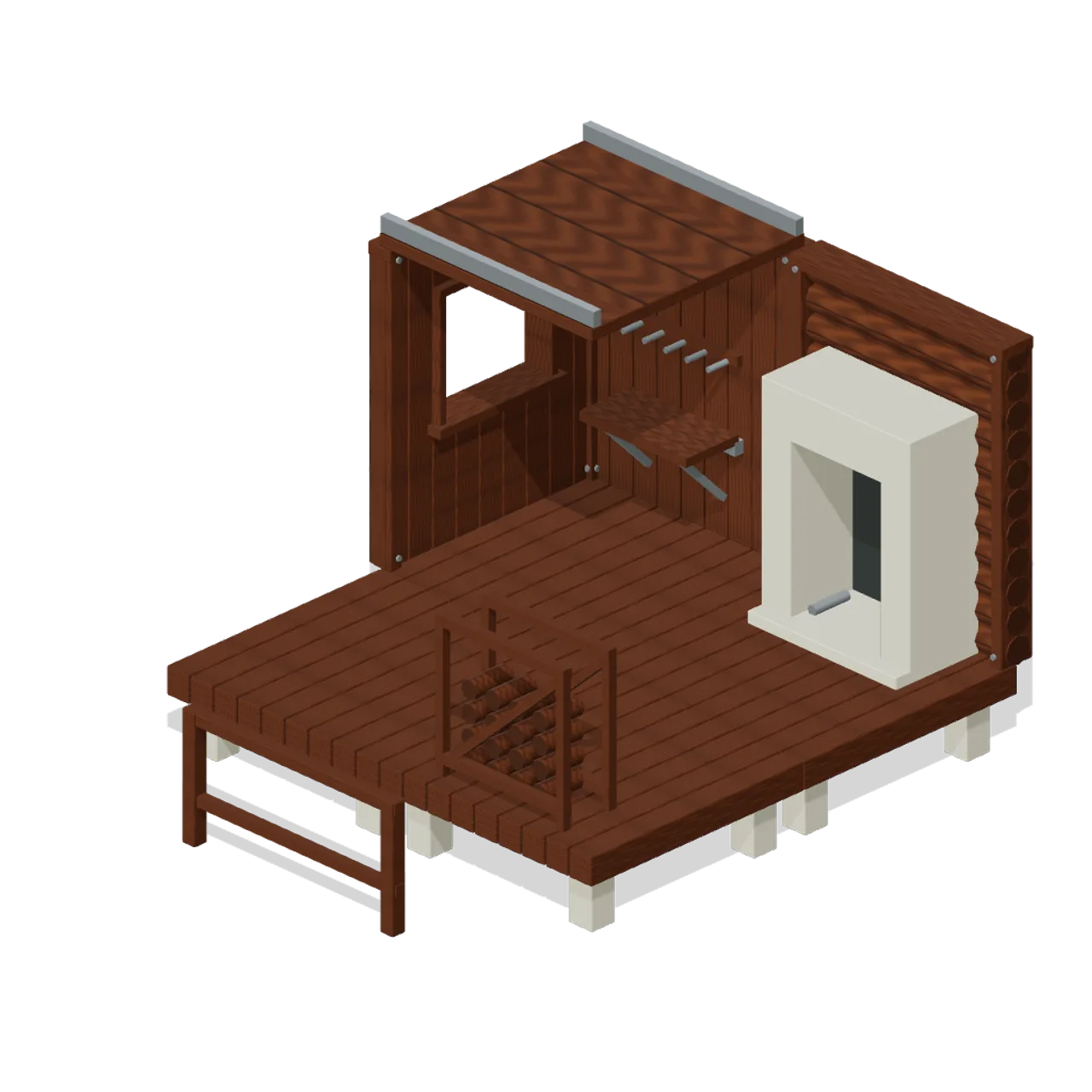 182 models
Modular Survival Base Builder
A 180-piece modular base builder: foundations, floors, walls with doors and windows, roofs, stairs and ramps in timber, log, wattle, corrugated and rubble finishes, all snapping to one grid.
AI used in 182 of 182 files · Claude Fable 5.1
 55 models
Live Music Venue and Festival Stage
Realistic live music models: modular stage decking, box truss and ground support, LED wall panels, line arrays, subs and wedges, a front of house desk, moving lights, the backline a band loads in, crowd barrier, and the stalls, flags and site kit around a festival field.
AI used in 55 of 55 files · Claude Opus 5
 49 models
Community Sports Hall and Changing Rooms
Realistic kit for a municipal multi use sports hall: a marked sprung floor, retractable basketball units, court posts and nets, wall bars and padding, mats and vaulting kit, changing rooms, showers, lockers, reception and the equipment store.
AI used in 49 of 49 files · Claude Opus 5
 56 models
Care Home and Day Room
Realistic residential care home: profiling care bed, bedside cabinet, over bed table, wardrobe, hoist track and mobile hoist, high back chairs, fireplace, tea trolley, nurse station, medication trolley, walk in bath, wheelchair, and wall, door and floor modules.
AI used in 56 of 56 files · Claude Opus 5
 48 models
Music Recording Studio and Instruments
Realistic recording studio models: guitars, a five piece drum kit, amps and microphones for the live room, a mixing console, monitors, racks and a tape machine for the control room, and modular floors, treated walls and a glazed window.
AI used in 48 of 48 files · Claude Opus 5
 51 models
Public Aquarium and Marine Centre
A realistic public aquarium and marine visitor centre: a modular wall tank run, a walk through tunnel, touch and ray pools, the visitor route from ticket desk to cafe, and the plant room and wet benches behind the gallery wall.
AI used in 51 of 51 files · Claude Opus 5
 54 models
Dental Practice and Surgery
A realistic dental practice: two surgeries of chair, delivery unit, operating light, stools and ported cabinet runs, a sterilising room and model lab behind them, and a reception and waiting area, all laid out from modular floor, wall, partition and door bays.
AI used in 54 of 54 files · Claude Opus 5
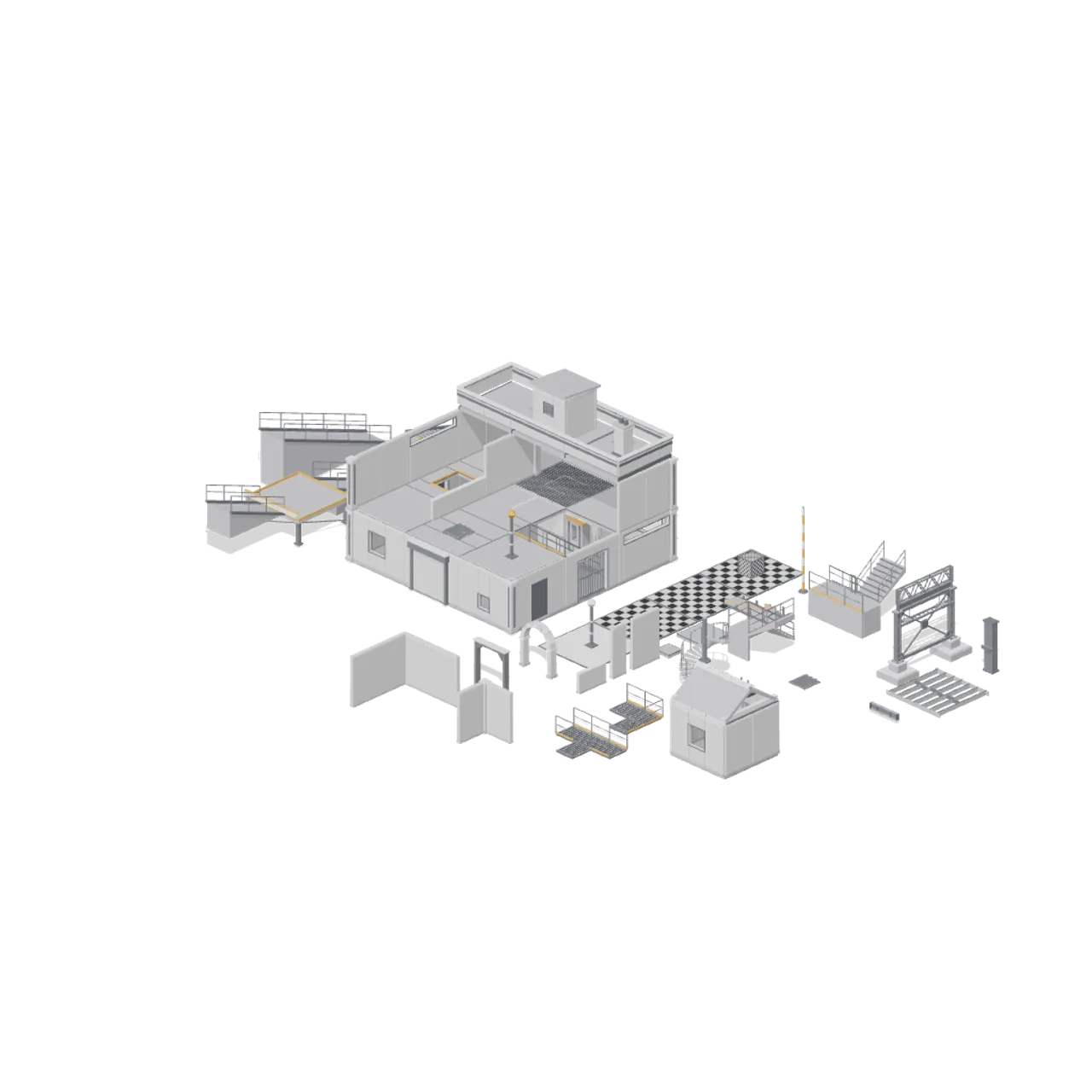 89 models
Modular Greybox Architecture Kit
Neutral 4 m grid prototyping kit: floors, walls, stairs, ramps, catwalks, animated doors, roofs, structure and blockout references.
AI used in 89 of 89 files · Claude Fable 5.1