Free models · Game-ready GLB
Exterior
Every historical model below is a self-contained .glb under 25 MB that drops into three.js, Blender, Godot, Unity and Unreal, free to use and modify in commercial projects without attribution.
Load one straight from its CDN URL with a plain GLTFLoader, or take a whole themed set from the packs.
684 free GLB models
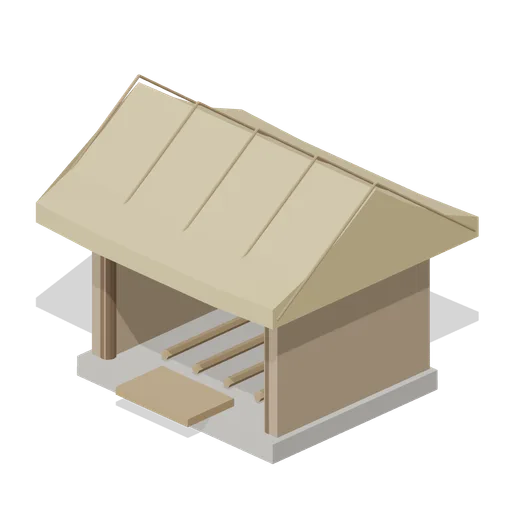
Thatched Outbuilding (Korean Hanok Village and Street)
A small store with clay walls on a stone footing, an open timber front and a straw thatched gable roof held down by a net of rope.
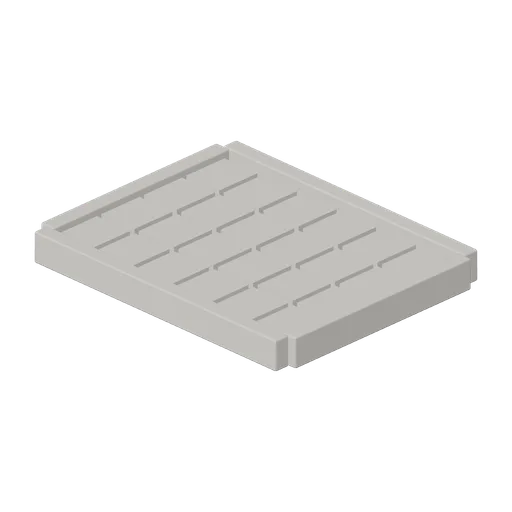
Jangdokdae Terrace (Korean Hanok Village and Street)
The raised stone terrace a household stands its fermentation jars on, with a kerb of dressed blocks and a swept flagged top.
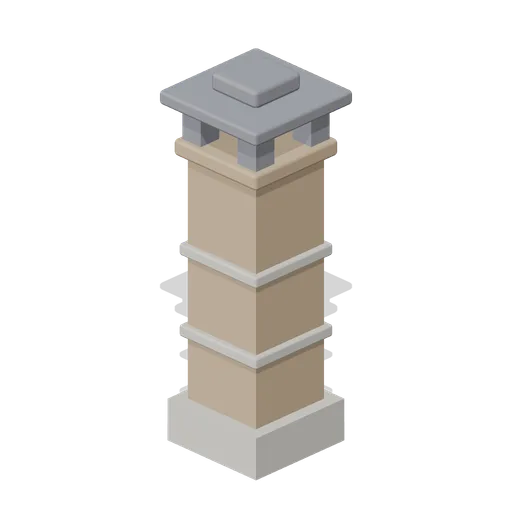
Chimney Stack (Korean Hanok Village and Street)
A free standing clay and stone chimney with a banded shaft and a small tiled cap, which is where a hanok flue comes up, well clear of the house.
 Animated
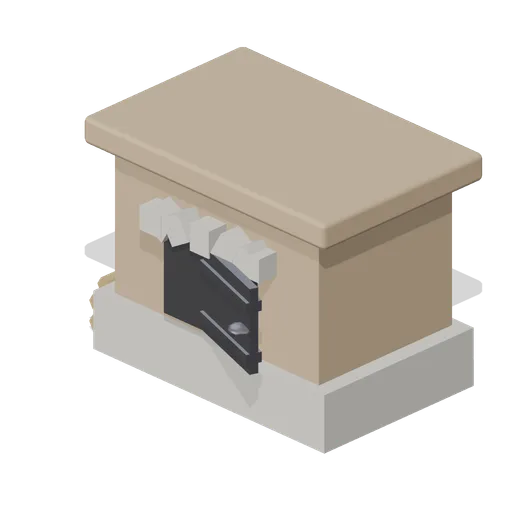
Ondol Firebox (Korean Hanok Village and Street)
The agungi that heats a hanok floor: a clay and stone block with an arched mouth, an iron door on a hinge, an ash pit and a stack of split wood beside it.
 Animated
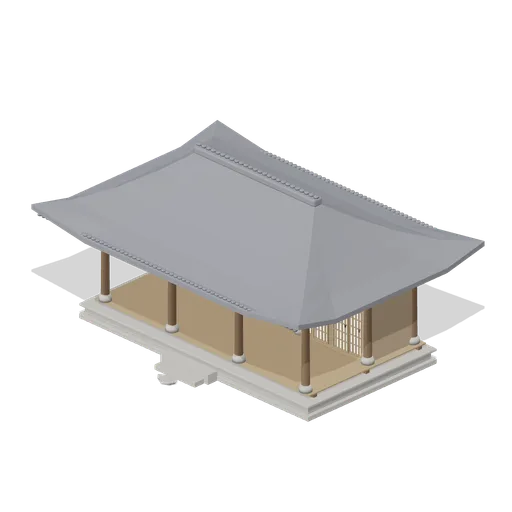
Hanok Main House (Korean Hanok Village and Street)
A three bay timber framed hanok on a stone plinth: an open maru floor in the middle, a papered room each side and a hip and gable tiled roof on exposed rafters.
 Animated
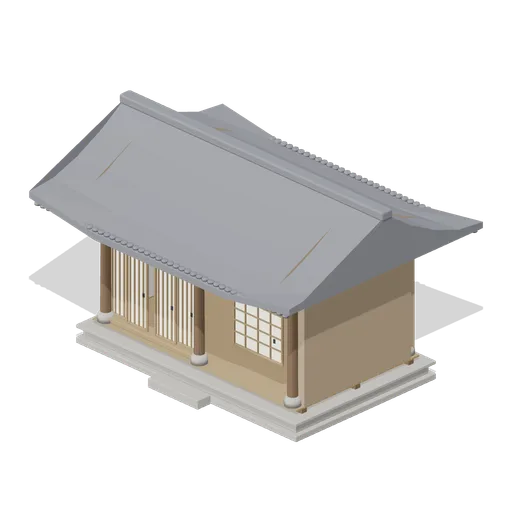
Hanok Side Wing (Korean Hanok Village and Street)
A smaller two bay hanok wing on a low plinth with a papered sliding front, a lattice window and a plain gabled tiled roof, for the side of a courtyard.
 Animated
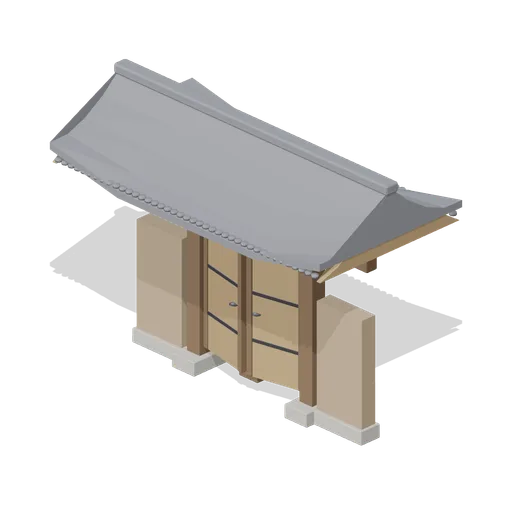
Village Gate House (Korean Hanok Village and Street)
A raised tiled gate house with two heavy timber leaves on iron straps, a stone threshold and clay flanking walls, sized to stand in a village wall run.

Ball Basket (Roman Bathhouse and Palaestra)
A 900 mm wicker ball basket holding six leather exercise balls, with a small oil jar set beside it. Court kit for the edge of a palaestra.

Punching Post and Bag (Roman Bathhouse and Palaestra)
A 2.6 m training post with a hanging sand bag: a turned timber post in a tufa footing with a bracket arm, an iron hook and a bound bag under it. The bag is modelled in one pose and stays still: a bag on a cord is a pendulum, and that is a joint, not a rigid node transform.

Discus and Javelin Rack (Roman Bathhouse and Palaestra)
A 1.5 m timber rack for throwing kit, 1.9 m tall: four javelins with bound grips and iron heads standing in two rails, and two bronze discuses resting at the foot. A palaestra prop, complete with its contents.

Stone Weight Set (Roman Bathhouse and Palaestra)
A training weight set on a timber pallet, 1.3 m across: three rough stone balls in graded sizes and two pierced lifting stones with rope sockets. The stones are separate solids on one base, not separate files.

Halteres Pair (Roman Bathhouse and Palaestra)
A pair of halteres: stone jumping weights 760 mm long, each two lobes on a shaped hand grip with a leather pad, lying on the ground where an athlete dropped them. Both weights are one model.

Stone Sundial (Roman Bathhouse and Palaestra)
A 1.9 m stone sundial: a turned travertine baluster on a square base carrying a marble dial block with eleven radial hour lines and a bronze gnomon. It is a fixed instrument and has no moving part: the shadow is the consumer's lighting, not an animation.

Statue Plinth with Draped Figure (Roman Bathhouse and Palaestra)
A moulded travertine plinth 1.1 m square with a red inlaid panel, carrying a 2.2 m draped stone figure: a fluted column of drapery, a shoulder mass, a cloak fold and a plain head block.

Bath House Vendor Stall (Roman Bathhouse and Palaestra)
A 2.2 m vendor stall for a bath house court: a tufa counter with a travertine top under a timber frame and a sloping awning, stocked with stacked cakes, oil jars, a tray of small flasks and a hanging valance marked with an abstract chequer.
 Animated
Water Lifting Wheel (Roman Bathhouse and Palaestra)
A timber water lifting wheel 3.1 m across on two tufa piers, with twelve rim buckets on a lead axle over a feed trough. The wheel is one named node and spins on its axle; the water in the trough is a still slab, and nothing pours, because a falling stream is not geometry.
 Animated
Bronze Stopcock Valve (Roman Bathhouse and Palaestra)
A bronze stopcock on a lead main, 950 mm tall: a cast body on a travertine block with a plug valve and a cross handle. The handle is a named node on the valve axis and turns; the water in the pipe is not modelled.

Furnace Wood Store (Roman Bathhouse and Palaestra)
A timber wood store for a bath house furnace, 2.4 m wide and 2 m tall: four posts carrying a plank roof over three courses of split logs stacked crosswise. Fuel for the praefurnium, and the only thing in the pack that is meant to be consumed.

Boiler Tank and Setting (Roman Bathhouse and Palaestra)
A bronze boiler tank on its brick setting, 2.2 m tall: a riveted drum banded in iron with a domed head, lifting lugs and lead feed and draw off pipes, standing over the flue of a furnace.
 Animated
Praefurnium Furnace Mouth (Roman Bathhouse and Palaestra)
A praefurnium furnace mouth 2.6 m wide: a brick faced stokehole with a voussoir arch, an iron door on a single hinge, the fire chamber behind it and a raked ash apron in front, under a projecting flue breast.

Dome Section with Oculus (Roman Bathhouse and Palaestra)
A 5.3 m dome on a low drum with an open oculus at the crown: a coffered shell of five rings on a moulded cornice, the eye ringed in marble. It is a section for capping a hot room, and the oculus is a real hole through the shell, so a scene under it is lit rather than sealed.

Arch Section (Roman Bathhouse and Palaestra)
A free standing arch section 4.7 m wide: two ashlar piers with marble impost bands carrying a semicircular ring of thirteen voussoirs and a raised keystone, springing at 2.4 m over a 3.3 m opening. One metre deep, so it reads as a wall thickness rather than a hoop.

Wall Pilaster Half Column (Roman Bathhouse and Palaestra)
A 3.9 m engaged half column for a wall face: a fluted shaft standing out of a flat pilaster back, on a moulded plinth with a Tuscan capital. Set it against a wall module so the back plate beds into the wall face.

Corinthian Column (Roman Bathhouse and Palaestra)
The same 3.9 m column carrying a Corinthian capital: two tiers of leaf blades round a bell under an abacus with a clipped corner, over a fluted shaft. The tallest capital of the three, for the hot rooms and the main hall.