3D Assets
@3dassets

Halteres Pair (Roman Bathhouse and Palaestra)
A pair of halteres: stone jumping weights 760 mm long, each two lobes on a shaped hand grip with a leather pad, lying on the ground where an athlete dropped them. Both weights are one model.

Stone Sundial (Roman Bathhouse and Palaestra)
A 1.9 m stone sundial: a turned travertine baluster on a square base carrying a marble dial block with eleven radial hour lines and a bronze gnomon. It is a fixed instrument and has no moving part: the shadow is the consumer's lighting, not an animation.

Palaestra Sand Court Module (Roman Bathhouse and Palaestra)
A 2 m palaestra sand court module 120 mm deep: a raked sand bed with shallow ridges and a scatter of scuffed hollows, with sand ports on all four edges so a whole exercise court tiles off one grid.

Statue Plinth with Draped Figure (Roman Bathhouse and Palaestra)
A moulded travertine plinth 1.1 m square with a red inlaid panel, carrying a 2.2 m draped stone figure: a fluted column of drapery, a shoulder mass, a cloak fold and a plain head block.

Amphora Rack (Roman Bathhouse and Palaestra)
A 1.6 m timber amphora rack 1.4 m tall: two shelves of cradle rails standing four terracotta amphorae in their saddles, which is how oil and wine were kept behind a stall. The jars are part of the model, not separate files.

Bath House Vendor Stall (Roman Bathhouse and Palaestra)
A 2.2 m vendor stall for a bath house court: a tufa counter with a travertine top under a timber frame and a sloping awning, stocked with stacked cakes, oil jars, a tray of small flasks and a hanging valance marked with an abstract chequer.

Towel Rack (Roman Bathhouse and Palaestra)
A 1.3 m timber towel rack 1.6 m tall: three turned rails between two posts on sled feet, with four folded linen towels hung over them. The towels are modelled in one pose and never move: a hanging sheet needs a cloth solver, which no rigid node transform can stand in for.

Masseur's Table (Roman Bathhouse and Palaestra)
A 1.95 m timber massage table 720 mm high: four turned legs with stretcher rails, a padded top and a bolster at the head, with an oil flask and a folded cloth left on it. It stands in the oiling room beside the palaestra.
 Animated
Bath House Storage Chest (Roman Bathhouse and Palaestra)
A 1.1 m timber storage chest with iron straps, bronze carrying rings and a hasp: what an attendant kept towels, oil and lamp fuel in. The lid is a named node hinged on its back edge and lifts.

Bronze Lamp Stand (Roman Bathhouse and Palaestra)
A bronze lamp stand 1.6 m tall: a three footed base, a turned baluster column and a cross arm carrying two oil lamps by their chains. Lighting for a corridor or a changing room. There is no flame and no light source: the lamps are cold geometry, and a consumer adds the light.

Hanging Oil Lamp (Roman Bathhouse and Palaestra)
A bronze oil lamp hung on three chains from a suspension ring, 940 mm from the ring to the nozzle. The origin sits at the ground under the lamp so the model settles like any other, and a scene lifts it to the ceiling by its ring.

Wall Niche with Urn (Roman Bathhouse and Palaestra)
A 1.1 m wall niche block 2.5 m tall: a round headed recess between marble pilasters under a moulded cornice, with a shelf and a plain lidded stone urn standing on it.

Bronze Brazier (Roman Bathhouse and Palaestra)
A bronze brazier 1 m across and 1 m tall: a three legged stand with hoof feet carrying a moulded pan of charcoal under a beaded rim. This is what warmed a room between the hot baths.

Strigil and Oil Flask Tray (Roman Bathhouse and Palaestra)
A bronze tray 540 mm across holding a bather's kit: two curved strigils for scraping oil off the skin, two globular oil flasks on loop handles and a small marble unguent pot, on a timber liner. Set it on a bench, a ledge or an attendant's table.
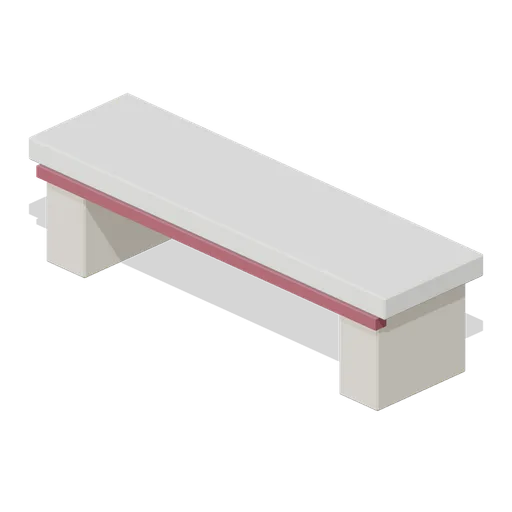
Stone Bench Run (Roman Bathhouse and Palaestra)
A 2 m stone bench run 540 mm high: a marble seat slab on two chamfered travertine piers with a red band under the front edge. Runs butt end to end along a wall, a colonnade or a changing room.

Still Water Surface Panel (Roman Bathhouse and Palaestra)
A 2 m square still water surface panel: a flat translucent slab 40 mm thick that tiles across an open air swimming pool at whatever level the scene sets.

Clothes Hook Rail (Roman Bathhouse and Palaestra)
A 1.6 m clothes hook rail: five bronze double hooks on a timber batten with iron end straps, for the wall over a changing bench. Mount it at the height a scene wants; the model rests on y=0 with the batten just above the ground.

Apodyterium Changing Bench with Cubbies (Roman Bathhouse and Palaestra)
A 2.4 m changing bench for an apodyterium: a travertine seat on three piers with a marble top, against a rendered back wall carrying two ranks of timber cubby shelves divided into eight openings, with a folded towel and a pair of sandals left in them.
 Animated
Water Lifting Wheel (Roman Bathhouse and Palaestra)
A timber water lifting wheel 3.1 m across on two tufa piers, with twelve rim buckets on a lead axle over a feed trough. The wheel is one named node and spins on its axle; the water in the trough is a still slab, and nothing pours, because a falling stream is not geometry.
 Animated
Bronze Stopcock Valve (Roman Bathhouse and Palaestra)
A bronze stopcock on a lead main, 950 mm tall: a cast body on a travertine block with a plug valve and a cross handle. The handle is a named node on the valve axis and turns; the water in the pipe is not modelled.

Drain Channel Run (Roman Bathhouse and Palaestra)
A 2 m drain channel run: a mortar trough between travertine kerbs, 320 mm high and 560 mm wide, open along its length for the overflow off a pool or a wash down floor. Runs butt end to end.

Lead Pipe Run (Roman Bathhouse and Palaestra)
A 2 m run of folded lead water pipe on two travertine saddles, 150 mm in the bore, with a soldered seam along the top, bronze collars at both joints and a strap at each bearing. Runs butt end to end along a wall or a trench.

Drain Channel Run with Grate (Roman Bathhouse and Palaestra)
The same 2 m channel closed with a bronze bar grate on a lead frame, which is what a bather walks over. Same channel ports, so grated and open lengths run together.

Water Spout Mask (Roman Bathhouse and Palaestra)
A carved stone spout head 560 mm square: an abstract rosette boss of concentric rings and twelve radial cuts on a travertine block, with a bronze nozzle through the middle. It is a pattern, not a face or a creature, so it carries no deity and no portrait.