
Loading scene
Walkable demo
Radio Telescope Array and Field Station
Walk a steppe radio astronomy station: thirteen dishes on their own bearings, a low band antenna field, traverse rails, the control and correlator cabins, the plant yard and the crew cabins inside the perimeter fence.
About
A radio astronomy field station on open steppe, laid out as one working site rather than a lineup. The track comes in from the south over a cattle grid and through the vehicle gate in the perimeter fence, past the blank visitor board and the windsock, and runs up to the hardstanding apron in the middle of the plot.
What is placed
Thirteen parabolic dishes stand across the northern half: two nine metre reflectors, four six metre and seven three metre, each turned to its own bearing so the field reads as instruments tracking rather than a row of parked mounts. A traverse rail runs down the east side with the bogie part way along it, the dish transporter at the rail head, and a pedestal, counterweights and a feed horn assembly laid out on the ground for a mount that is still going up. The low band antenna field takes the western quarter: nine dipole panels on one bearing, a row of log periodic booms and six small horn antennas. Open cable trenches run down from the dish field to the junction pits and on under cover to the correlator, so the groups read as one installation and not as separate props.
The middle of the site is the technical row: the control room cabin with its desk of blank screens, the correlator beside it, two signal racks, cryogenic receiver dewars and a service ladder. Behind them stands the plant line of helium compressor, diesel generator, battery shed, bulk fuel tanks and solar arrays. The service yard holds the spares racks, crate stacks, the forklift and the pickups. The crew cabins, site office, mess and two bunk cabins, sit inside the fence with the water tanks and the septic covers, and the weather and timing pad carries the anemometer mast, a tipping bucket rain gauge, the all sky camera and the GPS reference pillar. Scrub clumps, boulders and survey markers dress the open ground corner to corner, and two guyed masts give the plot its other verticals.
All fifty four published models in the pack are placed, 375 instances in total, for about one megabyte of GLB and roughly nineteen thousand triangles.
What moves
Each dish slews in azimuth and tilts in elevation as two separate named nodes. The rail bogie traverses its track and its deck clamps open, the transporter and the pickups roll on their own wheels, and the forklift lifts its mast as well as rolling. Cabin and shed doors swing, the signal rack and spares rack fronts open, the junction pit lid lifts, the anemometer spins, the all sky camera dome rotates and the vehicle gate swings. Twenty of the models carry clips and every one of them stands beside the walk.
What does not move, and why
Cabling, the guy wires on the masts, the windsock and the content of every screen are static geometry. Flexible material and a display need a joint per element or a shader, and neither is reachable with the one rigid node transform this library uses. There are no people anywhere on the site: the pack has no skinned meshes. The dishes vary in bearing but their elevation poses are part of the geometry, so a dish tilts only while its clip plays.
Every sign, board, screen and plate here is blank by design. This is a generic field station, not a real observatory, array or project, and nothing on it is named after one.
Every piece here is a published model from the pack, placed by hand. Walk with the keys or touch, and approach a piece to see it move if it has animation. Colliders, navigation and gameplay are yours to add.
Points of interest
The site gate
The track comes in over a cattle grid and through the vehicle gate in the perimeter fence. The gate leaf swings. Every sign, board and plate on this site is blank: nothing here is lettered, and nothing here is a real facility.
Perimeter Gate (Radio Telescope Array and Field Station)The nine metre dish
A parabolic reflector on an altazimuth yoke, with a feed horn on a quadripod at the focus and a counterweight behind the elevation bearing. It slews in azimuth and tilts in elevation as two separate nodes.
Large Parabolic Dish Antenna (Radio Telescope Array and Field Station)Control room and correlator
The control cabin with its desk of blank screens, the correlator beside it, two signal racks and a cryogenic receiver dewar. The cabin doors swing and the rack fronts open as you walk up to them.
Correlator Cabin (Radio Telescope Array and Field Station)The low band field
Dipole panels on one bearing, log periodic booms and small horn antennas in their own quarter of the plot. A phased array points by timing rather than by turning, so none of these moves.
Dipole Array Panel (Radio Telescope Array and Field Station)The traverse rails
A rail run down the east side for moving a mount between stations. The bogie traverses the track and its deck clamps open; the transporter parked at the rail head rolls on its own wheels.
Rail Bogie for a Movable Dish (Radio Telescope Array and Field Station)Power and plant
A helium compressor for the receivers, a diesel generator, a battery shed, bulk fuel and the solar arrays. Every shed door opens. The cable runs that link them are static geometry.
Diesel Generator Shed (Radio Telescope Array and Field Station)The crew cabins
Site office, mess and bunk cabins with a water tank on its stand and the yard behind. Doors, cabinet fronts and drawers open, and the forklift lifts its mast and rolls.
Mess Cabin (Radio Telescope Array and Field Station)Weather and timing
An anemometer mast, a tipping bucket rain gauge, an all sky camera and a GPS reference pillar on their own pad by the fence. The anemometer turns and the camera dome rotates.
GPS Reference Pillar (Radio Telescope Array and Field Station)
Use with an AI agent
Copy this prompt into your AI chat to rebuild the layout, then describe what to change.
Rebuild the "Radio Telescope Array and Field Station" demo scene from the Radio Telescope Array and Field Station pack in my project.

Layout (JSON, every placement with its CDN URL): https://3dassets.dev/api/v1/demos/radio-telescope-array-and-field-station
Pack manifest: https://3dassets.dev/api/v1/packs/radio-telescope-array-and-field-station
Demo page: https://3dassets.dev/demos/radio-telescope-array-and-field-station

- 375 placements of 54 models; units are metres, +Y up, rotation is yaw in degrees about +Y
- Spawn at (0, 0.2, 29.4) facing 180 degrees; eye height 1.6 m
- Licence: CC0 1.0 Universal (no attribution required)
- Loading: three.js GLTFLoader, one load per distinct model, cloned per placement; no decoders required
Also available as JSON or Markdown, and via the MCP server.
Common questions
How do I use Radio Telescope Array and Field Station with my AI development tools?
How do I get started?
Which game engines and tools can I use Radio Telescope Array and Field Station with?
How do I import this scene into Unity, Godot, Unreal or Blender?
Can I use Radio Telescope Array and Field Station in a commercial game, and do I need to credit anyone?
Can I load it from the CDN instead of downloading it?
Is the demo itself a file I can download?
Can I change the scene, or add gameplay to it?
Models in this demo

Pale Steppe Ground Module (Radio Telescope Array and Field Station)
An eight metre ground module in pale dry earth with small stones scattered across it, ported on all four edges so a plot is tiled from it.

Dark Steppe Ground Module (Radio Telescope Array and Field Station)
The darker tone of the same eight metre ground module, for breaking up a large plot so it does not read as one flat colour.

Hardstanding Module (Radio Telescope Array and Field Station)
An eight metre concrete hardstanding module with kerb edges, the surface a yard, a dish pad or a cabin row stands on, ported to the same grid as the ground.

Track and Verge Module (Radio Telescope Array and Field Station)
An eight metre ground module carrying the site track: a graded running surface, a gravel shoulder either side and scrub on the verge, ported to the same grid as the ground.
 Animated
Large Parabolic Dish Antenna (Radio Telescope Array and Field Station)
A nine metre parabolic dish on an altazimuth pedestal: the turret slews about the vertical, the reflector tilts about the yoke axle, and the quadripod feed and counterweight travel with it.
 Animated
Medium Parabolic Dish Antenna (Radio Telescope Array and Field Station)
A six metre parabolic dish on the same altazimuth pedestal as the large machine, sized for the middle of a field array, with a slewing turret and a tilting reflector.
 Animated
Small Parabolic Dish Antenna (Radio Telescope Array and Field Station)
A three metre parabolic dish on a short pedestal, the outrigger of a field array or a monitoring antenna beside the cabins, slewing and tilting on its own nodes.

Dish Pedestal Base (Radio Telescope Array and Field Station)
The pedestal a dish stands on, on its own: a stepped concrete foundation, a tapered column with a service door, a climbing ladder and the bolted bearing ring that takes the turret.

Dish Counterweight Block (Radio Telescope Array and Field Station)
A ballast block for the back of a dish yoke: a cast mass in a steel frame with a lifting eye on top, banded red, resting on its own pad.

Dish Feed Horn and Quadripod (Radio Telescope Array and Field Station)
A spare dish feed assembly on its transport frame: the flared horn, the receiver box behind it and the four legs that carry it at the focus, stood on a concrete pad.

Dish Rail Track Section (Radio Telescope Array and Field Station)
A six metre section of the rail a movable dish traverses: a ballast bed, sleepers across it and two rails on chairs, ported end to end so a run is as long as the site needs.
 Animated
Rail Bogie for a Movable Dish (Radio Telescope Array and Field Station)
The powered carriage a movable dish rides on: a welded deck with the turret bearing on top, drive boxes on both ends and four flanged wheels, traversing along its rails as one node.
 Animated
Dish Transporter (Radio Telescope Array and Field Station)
The six wheeled low loader that moves a reflector across the site: a cab, a dropped bed with a cradle ring and stabiliser legs, and six wheels that roll on their own nodes.

Guyed Mast with Anchors (Radio Telescope Array and Field Station)
A nine metre triangular lattice mast with a climbing ladder, a whip on the headframe and three guys running down to their own cast anchor blocks with lifting eyes.

Dipole Array Panel (Radio Telescope Array and Field Station)
A flat eight element dipole array on a reflecting screen: two rows of crossed dipoles on stand-offs, a braced frame behind them and the combiner box at the foot.

Log Periodic Antenna (Radio Telescope Array and Field Station)
A log periodic boom antenna on a short mast: nine elements shortening towards the feed end, staggered either side of the boom, with the balun box at the back.

Small Horn Antenna (Radio Telescope Array and Field Station)
A pyramidal horn antenna on a three leg stand: four flared panels opening forward from a waveguide throat, with the receiver box behind it, standing on its own pad.

Open Cable Trench Section (Radio Telescope Array and Field Station)
A four metre run of open cable trench: concrete kerbs either side, a sand bed between them, three bundled cables on it and the steel straps that hold them down.

Cable Trench Cover Run (Radio Telescope Array and Field Station)
The precast cover that closes a cable trench: four slabs laid end to end with lifting eyes and the edge strips that seat them, ported to the same four metre module as the trench.
 Animated
Signal Junction Pit (Radio Telescope Array and Field Station)
A cast junction pit where trench runs meet: a chamber with three cable ways across it, a red marker plate on the front and a steel lid hinged on its back edge that lifts open.

Control Room Cabin (Radio Telescope Array and Field Station)
The cabin the station is run from: an open fronted unit under a deep roof with a desk across the back wall, three blank screens on stands, a shelf and a stool.
 Animated
Correlator Cabin (Radio Telescope Array and Field Station)
The cabin that holds the correlator: a five metre insulated unit on a plinth with roof mounted cooling units, an equipment intake on the front and a hinged personnel door.
 Animated
Signal Equipment Rack (Radio Telescope Array and Field Station)
A floor standing signal rack: seven blank equipment faces with indicator blocks, a fan tray on the roof and two mesh doors that swing open from the middle.

Cryogenic Receiver Dewar (Radio Telescope Array and Field Station)
The vacuum dewar a cooled receiver lives in: an insulated vessel on four legs with a clamped flange, the cold head on top and two transfer lines rising from it.

Service Ladder (Radio Telescope Array and Field Station)
A three metre aluminium service ladder with rubber feet and hooked top rails, leant against a cabin or a tank while work is going on.
 Animated
Spares Rack (Radio Telescope Array and Field Station)
The spares rack from the store: an open steel frame of four shelves with three shallow drawers that pull out and blank part boxes stood on the top shelf.
 Animated
Helium Compressor Shed (Radio Telescope Array and Field Station)
The shed that holds the compressors for the cooled receivers: a small blockwork unit with louvred intakes down one side, an exhaust fan and a hinged door.
 Animated
Diesel Generator Shed (Radio Telescope Array and Field Station)
The standby generator shed: a lined unit with louvred air intakes, a radiator discharge on the front, an exhaust stack through the roof and a hinged door.
 Animated
Battery Shed (Radio Telescope Array and Field Station)
The battery room for the station: a ventilated white unit with intake slots across the front, a roof extract unit and a hinged door.

Bulk Fuel Tank (Radio Telescope Array and Field Station)
The bunded fuel tank that feeds the generator: a horizontal vessel on concrete saddles with end bands, a fill point on top, a dispensing cabinet and a guard rail along the front.

Solar Panel Array (Radio Telescope Array and Field Station)
A four module ground mounted solar array on a fixed tilted frame, with the string box at one end, sized to top up the station batteries between generator runs.

Septic Tank Cover (Radio Telescope Array and Field Station)
The lid of the buried septic tank: a concrete surround with a sealed access cover, a lifting eye and the vent pipe rising beside it.

Ladder Safety Cage (Radio Telescope Array and Field Station)
A caged climbing ladder section: four metres of rungs inside six back hoops on their longitudinal stringers, the fall protection on a mast or a tank stand.

Supply Crate Stack (Radio Telescope Array and Field Station)
A stack of banded supply crates on a pallet, with two more set down beside it: the delivery a remote station runs on, in blank white and grey cases.
 Animated
Yard Forklift (Radio Telescope Array and Field Station)
The station forklift: a counterbalance truck with a canopy and a two stage mast, whose carriage and forks lift on their own node and whose four wheels roll.
 Animated
Site Pickup (Radio Telescope Array and Field Station)
The station pickup: a plain double cab body with a dropside bed, a light bar over the cab and four wheels that roll on their own nodes.
 Animated
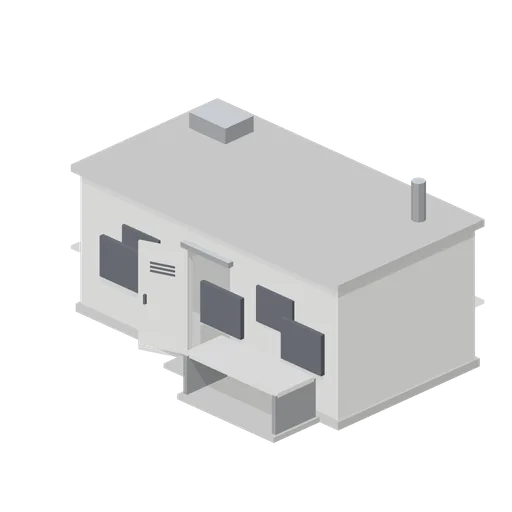
Site Office Cabin (Radio Telescope Array and Field Station)
The station office: a six metre portable unit on a plinth with a wide window, a canopy over the entrance step, an air conditioner on the roof and a hinged door.
 Animated
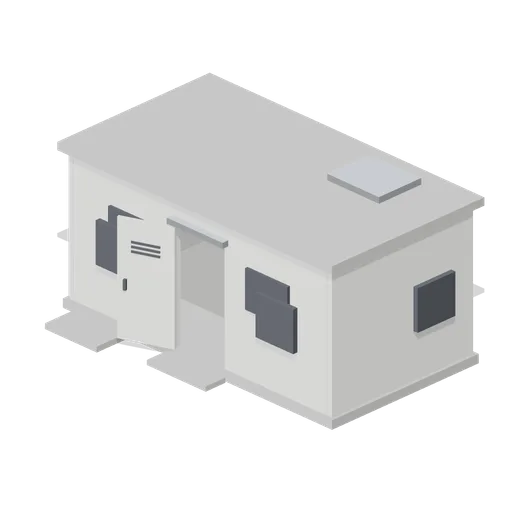
Mess Cabin (Radio Telescope Array and Field Station)
The crew mess: a wide portable unit with three windows, a roof mounted cooling unit and a flue, and a bench table on a hardstanding outside the door.
 Animated
Bunk Cabin (Radio Telescope Array and Field Station)
Sleeping accommodation for a remote shift: a portable unit with small windows on three sides, a water tank cradle on the roof and a hinged door onto a step slab.

Water Tank on Stand (Radio Telescope Array and Field Station)
The station water supply: a braced steel stand carrying a domed tank at three metres, with a climbing ladder, a down pipe and the pump box at the foot.
 Animated
Weather Mast with Anemometer (Radio Telescope Array and Field Station)
A five metre lattice weather mast carrying a three cup anemometer that turns on its own node, a radiation shielded temperature probe and the logger box at the foot.
 Animated
All Sky Camera Dome (Radio Telescope Array and Field Station)
The all sky camera on its cabinet: a weatherproof base with the equipment door on the front and a rotating dome with a dark window that turns on its own node.

GPS Reference Pillar (Radio Telescope Array and Field Station)
A survey grade reference pillar: a cast monument on a spread footing with a forced centring plate, the antenna and its choke ring on top and a receiver box on the shaft.

Tipping Bucket Rain Gauge (Radio Telescope Array and Field Station)
A tipping bucket rain gauge on a short post: the collecting funnel in its housing, the logger box on the post and a small concrete footing.
 Animated
Perimeter Gate (Radio Telescope Array and Field Station)
The vehicle gate in the perimeter fence: two mesh leaves on their own hinge posts under a head rail, each swinging out of the opening on its own node.

Perimeter Fence Run (Radio Telescope Array and Field Station)
A four metre welded mesh fence panel on its own footings, with top and bottom rails, ported left and right so a perimeter is as long as the plot needs.

Cattle Grid (Radio Telescope Array and Field Station)
The cattle grid where the track crosses the perimeter line: a sunk pit under a run of steel bars in a concrete surround, with a red marker post at each side.

Visitor Information Board (Radio Telescope Array and Field Station)
The information board at the station entrance: a wide panel on two posts under a weather hood, with blank inset panels where a site plan and notices would be fixed.

Windsock Mast (Radio Telescope Array and Field Station)
A four metre windsock mast with the sock flying from its hoop, the wind reference for a remote plot and its helicopter pad.

Warning Sign (Radio Telescope Array and Field Station)
A freestanding warning sign at the station boundary: a red bordered board with a blank face on a braced post and a small footing.

Floodlight Mast (Radio Telescope Array and Field Station)
A six metre floodlight mast carrying three tilted lamp heads on a crossarm, with the control box at the foot, for lighting the yard on a night shift.

Boulder Set (Radio Telescope Array and Field Station)
A group of six weathered boulders sitting low in the ground, for breaking up open steppe between the antennas.

Scrub Clump (Radio Telescope Array and Field Station)
A clump of dry steppe scrub: four bushes of different sizes with stalks standing round them, the ground cover of the plot between the dishes.

Survey Marker (Radio Telescope Array and Field Station)
A survey marker post: a small concrete footing, a steel post with a blank red plate and the levelling disc on top.